Radon Risks in Different Geographical Regions
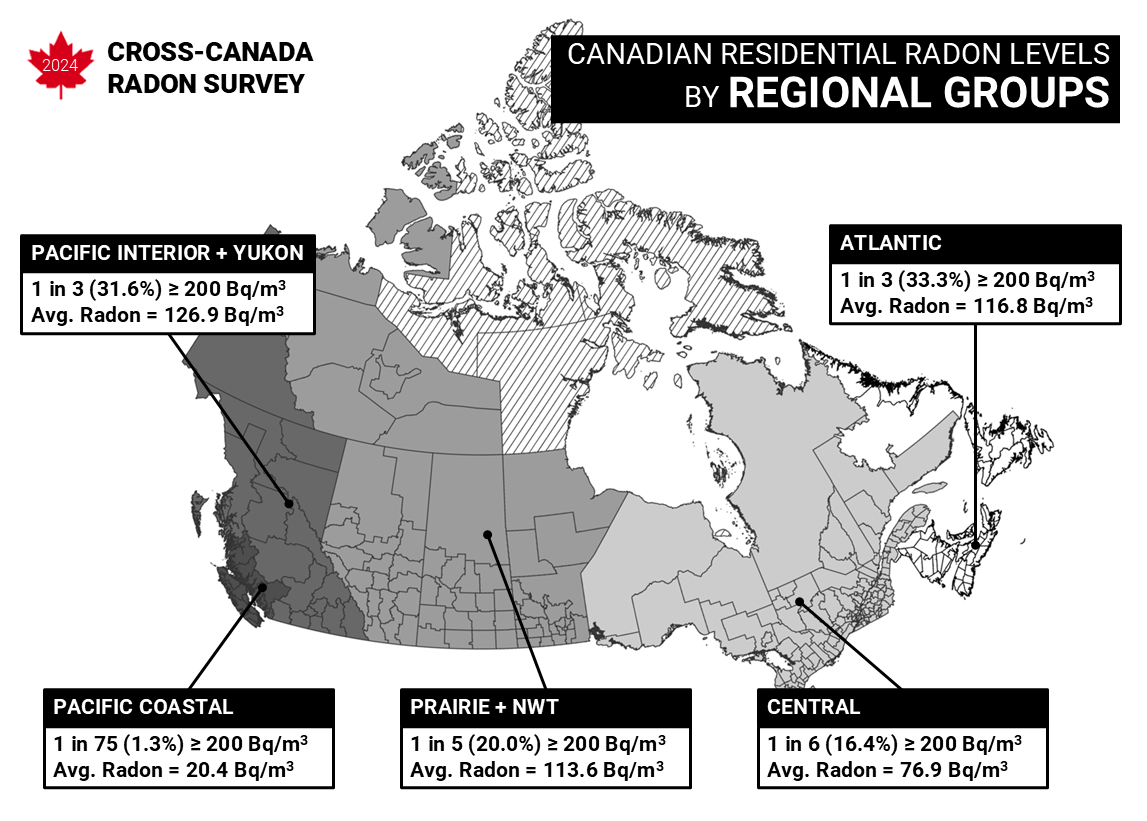
The KEY FINDINGS for a Canadian regional overview of residential radon levels are:
- 1 in 3 Atlantic properties are at or above 200 Bq/m³
- 1 in 6 Central properties are at or above 200 Bq/m³
- 1 in 5 Prairie and NT properties are at or above 200 Bq/m³
- 1 in 3 Pacific Interior and YT properties are at or above 200 Bq/m³1 in 75
- Pacific Coastal Canadian properties are at or above 200 Bq/m³
Radon levels across different Canadian residential building types
Radon levels in a building can vary significantly depending on various factors, including how that building is designed. To understand how differing building structures influence radon concentrations in Canada, household radon levels were sorted to allow a detailed examination of trends of high radon by building type. The three building type categories listed below encompass 69.6% (25.7 million people) of the total population of Canada (36.99 million people in the 2021 Census), with multifamily dwellings (such as apartments) making up the remaining 30.4%.
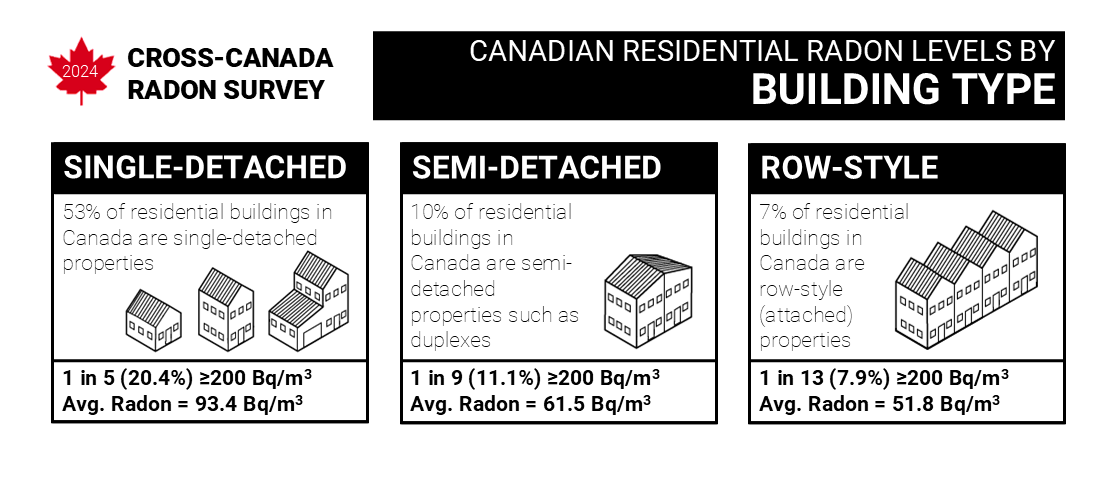
Single-detached houses: Single-detached houses, which encompass 53% of Canadian residences, exhibit the highest average indoor radon levels at 93.4 Bq/m³. In Canada, 1 in 5 (20.4%) Single-detached houses contain radon at or over 200 Bq/m³. 1 in 4 (26.4%) of these dwellings record levels between 100 and 199 Bq/m³.
- 1 in 5 Single-detached properties are at or above 200 Bq/m³ radon
Semi-detached houses: Semi-detached houses represent 10% of all Canadian residences, and show average radon levels of 61.5 Bq/m³. On average, semi-detached houses contain lower levels of indoor radon than detached houses. In Canada, 1 in 9 (11.1%) semi-detached houses contain radon at or over 200 Bq/m³. 1 in 5 (18.8%) semi-detached houses record levels between 100 and 199 Bq/m³.
- 1 in 9 Semi-detached properties are at or above 200 Bq/m³ radon
Row-style (attached) houses: Row-type houses represent 7% of all Canadian residences and show average radon levels of 51.8 Bq/m³. On average, row houses contain lower levels of indoor radon than detached or semi-detached houses, but these levels are still considered high in a global context. In Canada, 1 in 13 (7.9%) for row houses contain radon at or over 200 Bq/m³. 1 in 6 (15.6%) row houses record levels between 100 and 199 Bq/m³.
- 1 in 13 Row-style properties are at or above 200 Bq/m³ radon
The pan-Canadian data underscores significant differences across residential building types that impact indoor radon levels. These outcomes also emphasize that assessing the probability of high radon in the Canadian residential built environment needs to carefully consider housing type wherever possible.
Radon Levels in Canada, By Urban to Rural Community
As many different factors influence indoor radon levels, the analysis of household radon in Canada can be broken down further into separate variables such as community type. In this section, we report Canadian residential radon data for two distinct types of communities, those that are considered (i) ‘Urban’ and (ii) ‘Rural’ based on community population size.
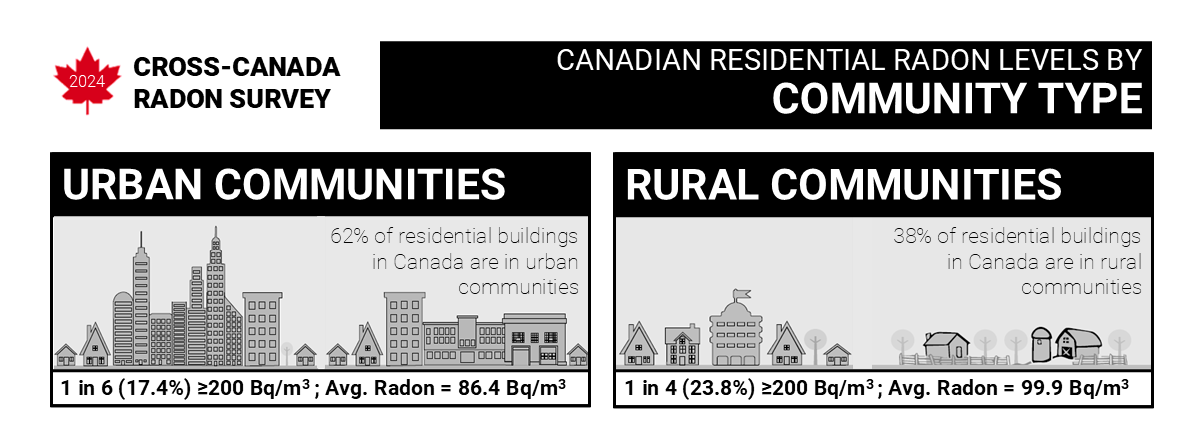
- 1 in 6 Urban community properties are at or above 200 Bq/m³
- 1 in 4 Rural community properties are at or above 200 Bq/m³
IMPORTANT: As a reminder, whether a community is considered more “Urban” versus more “Rural” is entirely dependent on population size. Our rural community group includes small towns, villages, hamlets and isolated properties where the population ranges from 1 person to 29,999 people in the community. By contrast, communities that are large towns and cities with populations of 30,000 people or greater are classed under the urban community group.
Urban communities: 62% of Canadian detached, semi-detached, and attached residences are found in more urban communities. Of these, 53% are in cities of 100,000 or more people, and 9% live in large towns of 30,000-99,999 people.
The average urban household radon levels were found to be 86.3 Bq/m³, with 1 in 6 (17.4%) of these buildings containing radon levels at or above 200 Bq/m3, while 1 in 4 (26.4%) were between 100 and 199 Bq/m³. Within more urban communities, radon levels across building types were:
1 in 6 Urban Single-detached properties are at or above 200 Bq/m³
1 in 8 Urban Semi-detached properties are at or above 200 Bq/m³
1 in 11 Urban Row-style properties are at or above 200 Bq/m³
The highest average radon levels in urban communities were observed in single-detached houses, with an average radon level of 86.3 Bq/m³. 1 in 6 (17.4%) urban single-detached houses contained radon levels greater than 200 Bq/m³, while 1 in 4 (26.4%) contained radon levels between 100-199 Bq/m³. Semi-detached and row houses in urban areas contained an average radon level of 66.6 Bq/m³ and 55.7 Bq/m³, respectively. Approximately 1 in 8 (12.6%) urban semi-detached and 1 in 11 (9.1%) urban row houses contained radon levels equal to or above 200 Bq/m³. In total, 20.2% of semi-detached and 15.9% of row houses in urban areas had radon levels between 100-199 Bq/³.
Rural communities: 38% of Canadian detached, semi-detached, and attached residences are found in rural communities. Of these, 15% are in small towns of 1,000-29,999 people, and 23% live in villages, hamlets or isolated properties of 1-999 people.
The average rural household radon levels were found to be 99.9 Bq/m³, with 1 in 4 (23.8%) of these buildings containing radon levels at or above 200 Bq/m³, while 1 in 4 (25.7%) were between 100 and 199 Bq/m³. Within rural communities, radon levels across different building types were:
- 1 in 4 Rural Single-detached properties are at or above 200 Bq/m³
- 1 in 8 Rural Semi-detached properties are at or above 200 Bq/m³
- 1 in 8 Rural Row-style properties are at or above 200 Bq/m³
Rural residential radon levels between detached and semi-detached buildings were 96.5 Bq/m³ and 75.8 Bq/m³, respectively. However, 1 in 4 (23.0%) detached houses were at or exceeded 200 Bq/m³, compared to almost 1 in 8 (12.2%) semi-detached houses. The average radon in a rural community row house was 61.6 Bq/m³, with 1 in 8 (12.5%) at or exceeding 200 Bq/m³. In total, 25.2% (detached), 25.5% (semi-detached), and 21.0% (row) of rural residential buildings contained 100-199 Bq/m³ radon.
From these findings, people living in Canadian rural communities experience higher average radon levels relative to those in urban communities, and a greater proportion of the rural Canadian population lives in houses with radon levels at or exceeding 200 Bq/m³. Canadian scientists have recently suggested that, in addition to differences in single-detached houses being more common in rural areas, another factor that contributes towards the higher rural radon trend is that rural community houses are more likely to be near one or more drilled groundwater wells. In this scenario, borehole gaps surrounding well casings may increase how easily underground radon can migrate up towards the soils underneath properties. Thankfully, the recommended solution to high radon in a rural property (following a standard radon mitigation process for the house) remains effective, and no direct action regarding wells is suggested at this time.